Last updated October 15, 2026
ADU Permits, Codes & Inspections in CA: What You Need to Know
California law requires most ADU permit applications to be approved or denied within 60 days. That sounds reassuring until you learn the clock doesn’t start ticking until your application is deemed “complete” – and “complete” means something very specific that catches most first-time applicants off guard. A missing site plan detail, an incorrect fee calculation, or a vague project description can push your approval timeline from two months to six. This guide walks through the real permitting process in California, with specific attention to how Thousand Oaks and Ventura County handle things, so you arrive at the building counter knowing exactly what to bring and what to expect.
Quick Answer
ADU permits in California are governed by state law (AB 2221, SB 897, and related bills) that caps approval timelines at 60 days, limits impact fees for units under 750 square feet, and overrides many local restrictions – but local building departments in Thousand Oaks and Ventura County still control application completeness, inspection scheduling, and specific code interpretations. A complete application needs a site plan, floor plan, structural drawings, energy calculations, and fee payment. Most projects go through three inspections: framing, rough mechanical/electrical/plumbing, and final.
Table of Contents
- What California State Law Actually Requires for ADU Permits
- What a “Complete” ADU Permit Application Looks Like
- How Thousand Oaks and Ventura County Add Local Requirements
- The Three Inspection Stages Every California ADU Goes Through
- Impact Fees for ADUs: What You Owe and What You Can Waive
- Why Unpermitted ADU Conversions Create a Title Problem
- Common Mistakes to Avoid
- When to Call a Professional
- Frequently Asked Questions
- The Bottom Line
What California State Law Actually Requires for ADU Permits
California has spent the last decade systematically stripping away local authority to block ADU construction. The state legislature’s position is unambiguous: accessory dwelling units are a public good, a low-cost housing solution, and local governments don’t get to say no just because neighbors complain. Here’s what state law now guarantees.
First, the 60-day rule. Under Government Code Section 65852.2, a local agency must approve or deny an ADU permit application within 60 days of receiving a complete application. If the agency fails to act within that window, the permit is deemed approved. This is a real enforcement mechanism, not a suggestion. But “complete” is doing a lot of work in that sentence, which we’ll get to shortly.
Second, ministerial review. Cities cannot require discretionary approvals – no public hearings, no design review boards, no conditional use permits – for ADUs that meet objective standards. If your ADU complies with the zoning code, the building department must approve it. End of process. In Thousand Oaks, this means a properly prepared application moves through the system without neighborhood notification or planning commission review.
Third, the 750-square-foot threshold. State law limits impact fees for ADUs under 750 square feet. Local agencies cannot charge school fees, park fees, or traffic mitigation fees on units this size. For ADUs between 750 and 1,000 square feet, fees must be proportional to the unit’s square footage relative to the primary residence. For ADUs over 1,000 square feet, standard local impact fees may apply.
Fourth, setbacks and height. State law caps minimum rear and side setback requirements at 4 feet for ADUs. A city can allow less, but cannot require more. Height limits must allow at least 16 feet for detached ADUs, and 18 feet if the ADU is within half a mile of a major transit stop or attached to the primary dwelling. These are state floor requirements – a city can be more generous, but never more restrictive.
Fifth, owner-occupancy requirements. Until 2020, cities could require the property owner to live in either the primary home or the ADU. State law eliminated that for ADUs permitted between January 1, 2020 and January 1, 2025. Local agencies could reinstate owner-occupancy requirements starting in 2025, but only for newly permitted ADUs, and only with a specific ordinance. In practice, most cities including Thousand Oaks have not rushed to bring this back.
What does this mean for a homeowner in Thousand Oaks planning a detached unit in the backyard? The state has already fought most of the zoning battles on your behalf. The remaining friction is paperwork, fees, and inspection logistics – which is where local knowledge and preparation make the difference between a 60-day approval and a six-month stall.
We’ve seen families arrive at the Thousand Oaks building counter with a napkin sketch and a can-do attitude. The city is generally cooperative with ADU applications – state law doesn’t leave them much choice – but cooperation doesn’t mean they’ll process an incomplete submission. The staff won’t call you to say “this site plan is missing the drainage line.” They’ll mark the application incomplete, stop the clock, and wait for you to resubmit. That’s the gap between what the state promises and what the counter actually delivers.
If you’re working with prefab brands like ADU Builders in Thousand Oaks who specialize in these systems, the structural engineering is typically handled by the manufacturer. That reduces one major source of application delay: incomplete or inadequate structural drawings. Boxabl and Plant Prefab, for example, provide California-compliant engineering packages that most building departments accept without revision. That’s a licensing and code issue solved before you ever sit down with a permit technician.
For a broader look at what goes into building an ADU from the ground up, including design options and construction timelines, start with our Seedling ADU Thousand Oaks home page. If you’re weighing an ADU against converting existing square footage, our Garage Conversion Contractor in Thousand Oaks page covers that path in detail.
What a “Complete” ADU Permit Application Looks Like
A complete application is a specific stack of documents, not a general description of what you want to build. Here’s what Ventura County and the City of Thousand Oaks expect to see before the 60-day clock starts.
1. Site Plan
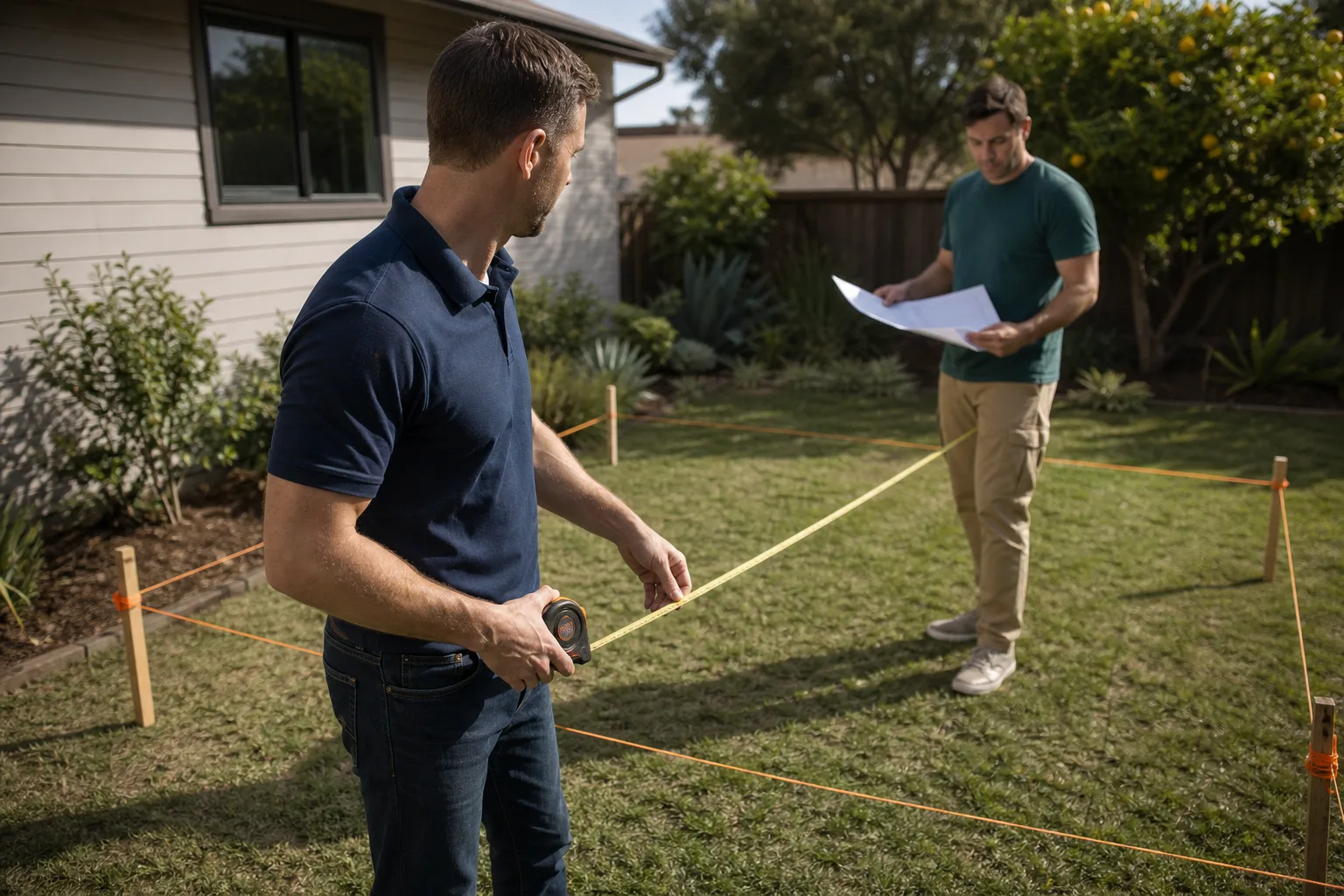
This is the document that triggers the most “incomplete” notices. Your site plan must show the property boundary, the footprint of the existing home, the proposed ADU location with dimensions, setback distances from all property lines, driveway and parking locations, existing trees over 6 inches in diameter, and the location of any easements. In Thousand Oaks, an oak tree ordinance adds an extra layer – protected oak trees can’t be removed or encroached upon without a separate permit, so the site plan needs to show oak canopy coverage if applicable. Most first-time applicants draw a rectangle for the ADU and call it done. The city needs more.
2. Floor Plan
Every room, every window, every door, with dimensions. Include the kitchen layout, bathroom fixtures, closet locations, and smoke detector placement. For ADUs, the floor plan must demonstrate compliance with California Building Code requirements for minimum room sizes, egress windows in sleeping areas, and accessible path of travel where required.
3. Structural Drawings
Foundation design, wall framing, roof framing, and connection details. If you’re building a site-constructed ADU, you’ll need a California-licensed structural engineer to stamp these. If you’re using a prefab system from Mighty Buildings or a similar manufacturer, the engineering package is often included with the unit – but you’ll still need a site-specific foundation design, because soil conditions in your Thousand Oaks backyard are not the same as the manufacturer’s default assumptions. We’ve seen hillside lots in the Conejo Valley require deeper footings than a flat-lot foundation detail would suggest.
4. Title 24 Energy Compliance
Every new ADU must meet California’s energy code. This typically means a Title 24 report generated by either a certified energy analyst or approved software, showing that the proposed insulation, windows, HVAC system, and water heating comply. This is not optional and it’s not something a contractor can hand-wave. If your ADU has a separate electrical panel, you’ll also need solar ready provisions or actual solar panels depending on the climate zone. Thousand Oaks falls in Climate Zone 8 or 9 depending on elevation, which affects the specific prescriptive requirements.
5. Fee Payment
The application isn’t complete until fees are paid. Building permit fees in Thousand Oaks are calculated based on the valuation of the project, which the city determines based on square footage and scope. You’ll pay plan check fees at submittal, then permit issuance fees when the plans are approved. We tell families to budget $3,000 to $8,000 for plan check and permit fees on a typical 400 to 800 square foot ADU, not counting impact fees, which are a separate category we cover below.
6. Soils Report (Sometimes)
Some lots in Thousand Oaks require a soils report before the foundation permit can be issued. This is particularly common in hillside areas, where expansive soils and slope stability are known issues. If your lot is flagged during plan check, you’ll need a geotechnical engineer to drill and test. Budget $2,500 to $5,000 for this if it’s required.
When we prepare an application for a family in Thousand Oaks, we assemble all six of these components before the first visit to the building department. That’s the difference between a 60-day clock that actually starts and one that resets every time you resubmit.
How Thousand Oaks and Ventura County Add Local Requirements
State law sets the ceiling for restrictions, but local governments control the floor for process. Thousand Oaks and Ventura County have their own ADU ordinances, application forms, and fee schedules that sit on top of state requirements. Here’s where local rules still matter.
Thousand Oaks uses the Ventura County building department for plan check and inspections under a contract arrangement, which means the paperwork goes through one set of hands but the local zoning check goes through another. The city planning division reviews the ADU application for zoning compliance first, then forwards it to the county for building code review. This split can add a week or two to the timeline, but it rarely causes denials if the zoning box is checked correctly on the front end.
Local zoning requirements that still apply in Thousand Oaks include: maximum lot coverage, which caps the total footprint of all structures on the property; height limits specific to the zone district (state law allows 16 feet minimum, but some R-1 zones in Thousand Oaks allow more); parking requirements (state law says one space per ADU unless the property is within half a mile of public transit, but Thousand Oaks requires proof of the transit qualification before waiving); and fire access requirements for properties in the wildland-urban interface, which includes much of the hillside residential area in Thousand Oaks.
Fire code is a big one here. If your property is in a designated Very High Fire Hazard Severity Zone – common in the hills north of the 101 – the ADU must comply with Chapter 7A of the California Building Code. That means ignition-resistant siding, ember-resistant vents, and specific window requirements. A Tuff Shed structure on a hillside lot needs to meet the same wildfire hardening standards as a site-built home. This isn’t a local obstacle; it’s a state code requirement that hits harder in our geography than it does in, say, Oxnard or Camarillo on the flats.
SB 897, which took effect in 2023, clarified several points that affect local enforcement. It prohibits local agencies from requiring replacement parking when a garage is converted to an ADU. It clarifies that ADUs can be sold separately from the primary residence in certain condominium arrangements, though this is rare in practice. And it allows local agencies to delay final inspection for up to 45 days for the purpose of collecting outstanding impact fees. That last provision means a city can legally hold your certificate of occupancy while you sort out a fee dispute – which is exactly the kind of surprise a family doesn’t want at the end of an eight-month build.
Our team works with the Thousand Oaks permitting office regularly. The people behind the counter are professional and consistent. They’re not looking for reasons to say no. But they are looking for completeness, and they don’t have the staffing to coach applicants through the process. If your contractor tells you they’ll “handle permits” and then submits a partial application, the city will mark it incomplete and the clock stops. We’ve seen this happen with out-of-area contractors who don’t know Ventura County’s specific documentation standards.
For families considering a home addition alongside or instead of an ADU, the permitting dynamics are different – additions don’t benefit from the same state law protections, and discretionary review can still apply in some cases. Our Home Addition Contractor in Thousand Oaks page walks through that process separately.
The Three Inspection Stages Every California ADU Goes Through
Once the permit is issued and construction begins, the building department tracks progress through a series of inspections. For ADUs, three stages matter most: framing, rough mechanical, and final. Each one requires scheduling with the inspector, having the work accessible, and passing before the next phase can begin.
Stage 1: Framing Inspection
This happens after the walls and roof are framed but before insulation and drywall cover the structure. The inspector is verifying that the framing matches the approved plans – stud spacing, header sizes, hold-down locations, roof connection details, and shear wall nailing patterns. For a prefab unit from Boxabl or Plant Prefab, the framing inspection may happen at the factory and be documented with a third-party inspection report; the local inspector then verifies the foundation and connection details on site. For site-built units in Thousand Oaks, expect the inspector to spend 30 to 60 minutes checking measurements against the stamped drawings. If the framing doesn’t match – a beam that’s an inch too shallow, a missing hold-down – the inspection fails and you reschedule, which can add a week to the timeline.
Stage 2: Rough Mechanical, Electrical, and Plumbing
After framing passes, the trades run their rough work: electrical wiring, plumbing supply and drain lines, HVAC ducting or mini-split lines, and any gas piping. The inspector verifies that this work meets the California Electrical Code, Plumbing Code, and Mechanical Code. Specific checks include: wire gauge and circuit sizing, AFCI/GFCI protection, drain slope and venting, water heater location and strapping (earthquake strapping is mandatory in California), and gas line pressure testing if applicable. The inspector also verifies that the work was done by licensed subcontractors – the permit will list the licensed electrical contractor and plumbing contractor, and the inspector may ask for proof of licensure.
Stage 3: Final Inspection
The final inspection happens after insulation, drywall, painting, fixtures, and finishes are complete. The inspector verifies that the finished ADU matches the approved plans in all material respects – room dimensions, window egress, smoke and carbon monoxide detector placement, stair and handrail dimensions, and door hardware. They’ll test GFCI outlets, check that windows in sleeping areas meet egress requirements, and verify that the water heater temperature is set to a safe level. They’ll also check exterior items: address numbers visible from the street, adequate drainage away from the foundation, and compliance with any fire hardening requirements if the property is in a high fire hazard zone. Once final inspection passes, the building department issues a certificate of occupancy, and the ADU is legal.
The inspection process is where the Cedarwell Care Promise matters in ways families don’t always anticipate. When the inspector is scheduled for 10 a.m., the site needs to be accessible and the work visible. That means the framing can’t be buried in construction debris, the electrical panel can’t be blocked by stored materials, and the approach to the ADU needs to be clear. Our crews leave the site clean at the end of every workday – a photo of the clean-up before the crew leaves is part of our standard process – which makes inspection days straightforward instead of a scramble.
Impact Fees for ADUs: What You Owe and What You Can Waive
Impact fees are charges cities levy on new development to pay for the public infrastructure that growth requires – schools, parks, roads, drainage systems. For ADUs, state law creates a clear fee structure based on square footage.
For ADUs under 750 square feet, local agencies cannot charge school impact fees, park fees, or traffic impact fees. This is a hard prohibition under state law, and it applies regardless of the ADU’s configuration – attached, detached, garage conversion, or prefab. If a city tries to assess these fees on a sub-750 square foot unit, the applicant can legally challenge the assessment.
For ADUs between 750 and 1,000 square feet, fees must be charged proportionally. If the primary residence is 2,000 square feet and the ADU is 800 square feet, the city can only charge 40% of the standard impact fee for a new single-family home of equivalent size. Most cities including Thousand Oaks simply bill the proportion directly, so the homeowner never has to request the adjustment.
For ADUs over 1,000 square feet, standard local impact fees apply. But here’s the nuance: school districts still collect mitigation fees on ADUs of any size unless the fees were specifically waived by the local ordinance. Ventura County school districts have generally been aggressive about collecting fees on larger ADUs, and these fees can run $3 to $5 per square foot. On a 1,200 square foot ADU, that’s $3,600 to $6,000 just for school fees alone.
When can you request a fee waiver? A few situations apply. If the ADU is being built to house a family member with a documented disability, some agencies will waive fees under their reasonable accommodation procedures. If the ADU is deed-restricted as affordable housing – meaning the owner signs a covenant limiting rent to affordable levels for a specified period – state law requires local agencies to reduce or waive fees. And if a city has a local ADU fee waiver program (some do, most don’t), the waiver process is specified in the local ordinance. Thousand Oaks does not currently have a general ADU fee waiver program, but the proportionality rules for mid-size ADUs effectively serve the same function for many families.
One point that surprises people: the timing. Some impact fees are assessed at building permit issuance, but Ventura County school district fees are often collected at the time of final inspection or certificate of occupancy. That means a family can think their project is fully paid, then face a $4,000 school fee bill at the end of construction. We disclose these fees in our written pricing from the start, so there’s no surprise line item waiting at the finish line. That’s the ADU Builders in Thousand Oaks approach: name the number before work starts, and make it stick.
Why Unpermitted ADU Conversions Create a Title Problem
An unpermitted ADU isn’t just a code violation – it’s a cloud on the property title. This is the point most homeowners don’t understand until they try to sell or refinance.
When you build an ADU without a permit, that square footage never appears in the official county record. The assessor’s office doesn’t know about it. The building department has no certificate of occupancy on file. When you list the home for sale, the seller disclosure forms require you to disclose unpermitted work – and if you fail to disclose, you’re liable for misrepresentation after the sale closes. Buyers who discover unpermitted additions can rescind the sale, sue for damages, or demand a price reduction to cover the cost of legalization or removal.
Refinancing is where the problem gets immediate. Lenders order an appraisal, and the appraiser compares the permitted square footage on the county record to the actual square footage on the ground. If there’s a 400-square-foot ADU that doesn’t exist in the public record, the appraiser can’t count it toward the home’s value. The loan to value ratio shifts, and the refinance can fail. We’ve talked to Thousand Oaks homeowners who built a garden cottage twenty years ago without permits, then discovered at refinance time that the “extra bedroom” they’d been counting as equity was legally invisible to their lender.
The legalization path is not simple. The city can require you to open walls to verify electrical and plumbing work, bring everything up to current code, pay back fees with penalties, and in some cases demonstrate that the structure meets current setback requirements – which it often doesn’t, because it was built without the benefit of the state’s ADU setback protections. If the unpermitted structure encroaches on a slope easement or sits inside a required fire clearance zone, the city may require removal rather than legalization.
California’s ADU amnesty programs have helped some homeowners, but they’re not automatic. You have to apply, the work has to be brought into compliance, and the process takes time. The state’s legislative direction has been toward amnesty rather than enforcement, but that’s a policy preference, not a guarantee. A Thousand Oaks family with an unpermitted garage conversion should treat it as a problem to solve now, not a problem that will disappear when they sell. It won’t.
If you’re considering converting an existing garage that was built with permits but never converted to living space, the situation is much better – the conversion itself can be permitted now under the state’s ADU streamlining laws. That’s a different conversation from trying to legalize work that was done illegally. Our Garage Conversion Contractor in Thousand Oaks page explains that distinction in more detail.
Common Mistakes to Avoid
- Submitting an incomplete site plan. The city of Thousand Oaks needs setbacks, easements, oak tree locations, and drainage patterns. A rectangle on a lot map doesn’t count. Fix this before you submit, not after the “incomplete” notice arrives.
- Assuming the 60-day clock starts when you hand over the paperwork. The clock starts when the application is deemed complete, which can be weeks after your initial submittal if the city finds gaps. Prepare every document in advance.
- Skipping the Title 24 energy report until after plan check starts. This is a common stall point. The energy report needs to accompany the plans, not arrive three weeks later.
- Underestimating school district fees on larger ADUs. Ventura County school districts collect fees at final inspection. Budget for them at the start, not as an afterthought.
- Using an out-of-area contractor who doesn’t know Ventura County’s process. The county will mark applications incomplete for things a local contractor would have included from the start. The permit counter isn’t a coaching service.
- Ignoring fire hardening requirements on hillside lots. Thousand Oaks’ wildland-urban interface zones require Chapter 7A compliance. If your plans don’t show ignition-resistant materials, plan check will send them back.
- Building without a permit and assuming it’ll be easy to legalize later. It won’t be. The amnesty process exists, but it’s expensive, slow, and doesn’t guarantee approval.
When to Call a Professional
If your ADU is a simple 400-square-foot project on a flat lot with no protected trees, no fire zone complications, and a straightforward foundation, an experienced owner-builder can sometimes navigate the permit process alone. But if your property includes any of the following, call a professional before you spend money on plans: hillside or sloping lot, protected oak trees, fire hazard zone designation, existing unpermitted work on the property, a garage conversion with structurally questionable framing, or a prefab unit from a manufacturer whose engineering package needs local adaptation. These are the situations where the gap between state law and local process gets wide, and where a mistake costs more than a consultant’s fee.
Seedling ADU Thousand Oaks offers free estimates in Thousand Oaks. Call (805) 309-3462 to talk through your specific property before you commit to anything.
Frequently Asked Questions
Building permit and plan check fees for a typical 400 to 800 square foot ADU in Thousand Oaks run $3,000 to $8,000, not including impact fees. Impact fees for units under 750 square feet are mostly prohibited by state law. For units over 1,000 square feet, school district fees can add $3 to $5 per square foot. Call (805) 309-3462 for a breakdown specific to your project size.
State law requires a decision within 60 days of a complete application. In Thousand Oaks, plan check typically runs 4 to 8 weeks after completeness is confirmed. Add 1 to 2 weeks for the city zoning review and county building review coordination. If plans require revisions, each resubmittal resets part of the clock.
No. ADU permits are ministerial, meaning the city must approve a compliant application regardless of neighborhood opposition. There is no public hearing for a standard ADU permit in Thousand Oaks. Neighbor objections carry no legal weight in the process as long as the ADU meets all objective zoning and building standards.
Not always. Flat lots with no history of expansive soil issues typically skip this requirement. Hillside lots, lots with known slope instability, and lots in certain geotechnical hazard zones will need a soils report before foundation approval. Budget $2,500 to $5,000 if your lot requires one.
The unpermitted square footage doesn’t exist in public records, so it won’t count in an appraisal, and you must disclose it during the sale. Failure to disclose creates liability for the seller. Some transactions fall through when lenders discover unpermitted work. Legalization is possible but expensive and not guaranteed.
The permit application is the same, but the engineering package is typically superior because it’s been reviewed by the California Department of Housing and Community Development at the factory level. Local plan check still reviews the foundation design, site plan, and utility connections. The advantage is fewer structural revisions, not a shorter application.
The Bottom Line
California’s ADU permitting law is genuinely homeowner-friendly. The 60-day clock, ministerial approval, fee limitations, and setback caps are real protections that didn’t exist a decade ago. But friendly law doesn’t mean frictionless process. The building department in Thousand Oaks still requires a complete application, still schedules inspections on their timeline, and still collects fees that surprise people who didn’t plan for them. Prepare the documents thoroughly, understand which local rules still apply, budget for fees beyond the permit itself, and treat unpermitted work as the liability it is. If you want certainty about what your ADU will cost and when it will be done, call Seedling ADU Thousand Oaks at (805) 309-3462 for a free estimate and a written price before any work begins.
Written by Ben Ortega, Owner at Seedling ADU Thousand Oaks, serving Thousand Oaks since 2001.