Last updated October 15, 2026
How to Hire a ADU Contractor in Thousand Oaks: A Step-by-Step Guide
Here’s a pattern we see repeatedly in Thousand Oaks: the contractor who wins the bid is often the one who asked the fewest clarifying questions, because they planned to figure out the details later, at your expense. A low number on a proposal feels like certainty until the change orders start arriving. This guide walks you through how to screen for the contractor who will still answer the phone the day after the crew packs up, using the specific tools available to Thousand Oaks homeowners: the CSLB database, written line-item pricing, warranty language, and the interview questions that reveal how a contractor handles surprises mid-project. For more guides & resources on ADU construction, visit our blog.
Quick Answer
To hire an ADU contractor in Thousand Oaks, verify the contractor’s license status and disciplinary history on the CSLB database, request a written line-item price that itemizes permits, site work, utility connections, and finish allowances, confirm both workmanship and materials warranties in the contract, and interview at least three contractors using questions that reveal how they handle mid-project surprises. The goal is not the lowest bid; it is the contractor who remains reachable and accountable after the final invoice is paid.
Table of Contents
- Step 1: Verify the License on the CSLB Database Before the First Meeting
- Step 2: Ask the Five Interview Questions That Reveal How a Contractor Handles Surprises
- Step 3: Read a Written ADU Price Like a Thousand Oaks Homeowner, Not a Tourist
- Step 4: Understand the Two Warranties That Must Appear in Your Contract
- Step 5: Recognize Red Flags and Green Flags Specific to Thousand Oaks ADU Projects
- Step 6: Compare Bids Without Falling for the Lump-Sum Trap
- Common Mistakes to Avoid
- When to Call a Professional
- Frequently Asked Questions
- The Bottom Line
Key Takeaways
- Thousand Oaks sits in Ventura County, and ADU permit requirements follow both state law and local zoning rules. A contractor who dismisses local specifics before seeing your lot is guessing.
- The CSLB license lookup takes five minutes and shows disciplinary actions, workers’ compensation status, and whether the license is active. Do this before the first phone call.
- A complete written ADU price itemizes permits, site work, utility connections, and finish allowances. A lump-sum number leaves room for costs to grow after the contract is signed.
- Two warranties matter: workmanship (the contractor’s labor) and materials (the manufacturer’s product). Both should appear in writing before you sign.
- Thousand Oaks lots vary from flat Newbury Park parcels to sloped hillside sites near Wildwood. Site conditions drive real cost differences, and a careful contractor will ask about slope, access, and drainage before pricing.
Step 1: Verify the License on the CSLB Database Before the First Meeting
California requires every contractor performing ADU work valued at $500 or more to hold a valid license from the Contractors State License Board. The CSLB database is public, free, and takes less than five minutes to use. Here is exactly what to check, and what each field actually tells you about a Thousand Oaks ADU contractor.
- License status: Look for “Active.” Any other status, such as “Suspended,” “Expired,” or “Revoked,” is a hard stop. A contractor with an inactive license cannot legally pull permits for your ADU in Thousand Oaks.
- Classification: For an ADU, the license should be Class B (General Building) or a Class A (General Engineering) contractor working with a licensed builder. A specialty C license alone, like C-36 plumbing, is not sufficient to build an entire ADU.
- Workers’ compensation insurance: If the contractor has employees, workers’ comp coverage must appear on the license record. Without it, you can be held liable if a worker is injured on your Thousand Oaks property.
- Disciplinary history tab: This is the field the sales conversation will never mention. Click it. Look for complaints filed by past clients, citations from the CSLB, or settlement records. One resolved complaint from ten years ago may be explainable. Multiple complaints within the last three years are a pattern.
- Business address and personnel: Confirm the address on file matches the business card you were handed. If the license shows a P.O. box in another county while the salesperson claims a local Thousand Oaks office, ask why.
We have seen Thousand Oaks homeowners discover suspended licenses, mismatched addresses, and undisclosed disciplinary actions this way, all during the first five minutes of research. The database exists for exactly this purpose. Use it before you invite anyone to your property.
After the license check, the next step is the conversation that reveals more than any proposal ever will. Our ADU Builders in Thousand Oaks guide covers the local building process in more detail, but the interview questions below should be asked before any paperwork is signed.
Step 2: Ask the Five Interview Questions That Reveal How a Contractor Handles Surprises
Every ADU project in Thousand Oaks will encounter at least one surprise. A hillside lot in the Conejo Valley may hide unexpected soil conditions. A 1960s-era garage conversion in the Waverly neighborhood may reveal wiring that was never permitted. The contractor’s answers to five specific questions will tell you more than any portfolio photo.
Question 1: “Walk me through what happens when you find something unexpected during site work. Who decides, who pays, and how am I told?”
A reassuring answer sounds like this: “We stop work on that item, document what we found with photos, bring you a written change order with the exact added cost, and we do not proceed until you approve it in writing.” A red flag sounds like this: “We’ll figure it out, don’t worry, we handle surprises all the time.” The first answer tells you the contractor has a process. The second tells you the contractor has a habit.
Question 2: “Which parts of this project will require a permit in Thousand Oaks, and who pulls them?”
The correct answer includes electrical, plumbing, structural, and grading permits where applicable, pulled by the contractor or the homeowner with clear written responsibility assigned. In Thousand Oaks, the city’s building and safety division reviews ADU plans, and Ventura County may have jurisdiction over certain site conditions. See ADU Permits, Codes & Inspections in CA: What You Need to Know for a deeper look at requirements. A contractor who says “we’ll handle permits later” or “you don’t really need one for that part” is inviting a stop-work order onto your property.
Question 3: “Who is on-site every day, and are they your employees or subcontractors?”
There is nothing wrong with subcontractors. There is something wrong with not knowing who they are. Ask for names, license status of each sub, and whether the contractor’s workers’ compensation covers them. In Thousand Oaks, where many ADU projects sit close to neighbors and families are home during construction, knowing who is walking onto your lot matters. A careful contractor will volunteer this information without being asked twice.
Question 4: “What is your process for protecting the inside of my home during the build, especially if we’re doing a garage conversion attached to the house?”
You want to hear specifics: shoe covers, drop cloths, dust barriers, sealed doorways, and daily clean-up. General language like “we’re respectful” is not a process. A contractor working on garage conversions in Thousand Oaks should be able to describe exactly how they will protect your flooring, your air quality, and your pets before the first tool comes out.
Question 5: “How do you communicate with me during the project, and who do I call after hours?”
The answer should include a named point of contact, a regular update cadence, and a phone number that reaches a live person. If the contractor says “you can email me” and nothing else, imagine your ADU project stalled for three days while you wait for an email reply. Thousand Oaks homeowners deserve a direct line to the person accountable for the work happening on their property.
Step 3: Read a Written ADU Price Like a Thousand Oaks Homeowner, Not a Tourist
A complete, written ADU price should feel almost too detailed. That is the point. Every line item is a decision already made on paper instead of a decision that will be made later, at your expense. Here is what an itemized ADU proposal should include, and what each line protects you from.
| Line Item | What It Covers | What a Vague Version Looks Like |
|---|---|---|
| Permits and fees | City of Thousand Oaks plan check, building permit, school impact fees where applicable, utility connection fees | “Permits included” |
| Site work | Excavation, grading, drainage, retaining walls if slope requires, foundation | “Site prep” |
| Utility connections | Sewer or septic, water, electrical panel service, gas line where applicable, trenching | “Utilities hooked up” |
| Rough construction | Framing, roofing, windows, exterior doors, house wrap, siding | “Build the structure” |
| Finish allowances | Flooring, cabinets, countertops, fixtures, paint, trim, with specific dollar allowances per category | “Finishes included” |
| Mechanical systems | HVAC, water heater, electrical panel if upgraded, plumbing fixtures, insulation | “Mechanicals” |
| Site clean-up and hauling | Debris removal, dumpster, final cleaning | Absent entirely |
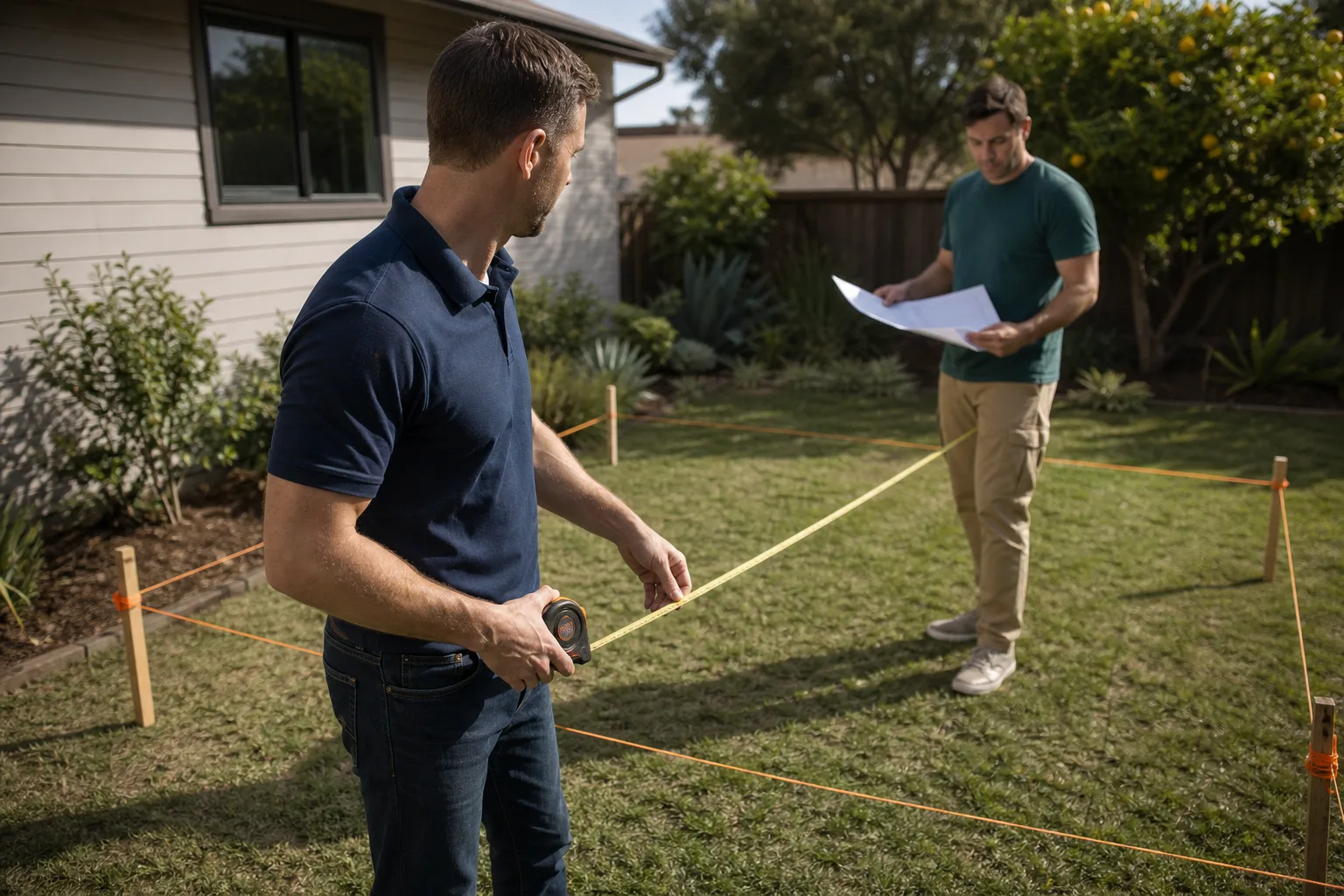
Thousand Oaks ADU costs vary widely based on lot conditions-see our ADU Cost Breakdown: The Thousand Oaks Homeowner’s Reference for 2026 for detailed figures. A flat detached ADU in Newbury Park will price differently than a hillside unit in the Lynn Ranch area that requires retaining walls and additional grading. A careful contractor will walk your lot, note the slope, the access path for equipment, and the location of existing utility lines before writing a single number. If a contractor hands you a proposal without visiting the site, set it aside.
Our approach has always been to provide a written price before any work starts, with no surprise line items added after the crew arrives. That is not a marketing phrase; it is the only way a family can plan around an ADU project without living in fear of the next invoice. For families considering a larger project, our Home Addition Contractor in Thousand Oaks page walks through the same pricing logic applied to additions.
Step 4: Understand the Two Warranties That Must Appear in Your Contract
A workmanship warranty and a materials warranty are different things, and both must appear in the contract before you sign. They protect you in different ways, and a contractor who blurs them together is either inexperienced or hoping you won’t notice.
Workmanship Warranty
This covers the contractor’s labor. If a door was hung incorrectly and begins to bind, if a section of roofing was installed poorly and leaks, if tile work cracks due to improper installation, the workmanship warranty requires the contractor to return and fix it at their own cost. California law requires contractors to provide a minimum one-year workmanship warranty on new construction, including ADUs. A contractor who offers longer, in writing, is putting a specific promise behind their labor.
Materials Warranty
This covers the products installed in your ADU, and it comes from the manufacturer, not the contractor. Windows, roofing, flooring, water heaters, mini-split HVAC systems, and appliances all carry their own manufacturer warranties. The contractor’s job is to pass those warranty documents to you and to install the products according to the manufacturer’s specifications, because an improper installation voids the materials warranty. Ask for the warranty paperwork for every major product before the project starts.
What the Contract Should Say
The contract should name the workmanship warranty period, state that the contractor will handle warranty claims during that period, and list the materials warranties that will be transferred to you upon completion. If the contract says “warranty included” without specifying what that means, ask for the language to be written out. At Seedling ADU Thousand Oaks, every completed ADU, garage conversion, and home addition is covered by our 365-Day Done Right Promise: if it is not done right, we make it right, in writing.
Step 5: Recognize Red Flags and Green Flags Specific to Thousand Oaks ADU Projects
Thousand Oaks homeowners report a consistent set of warning signs and reassuring signals after working with local ADU contractors. Here is the side-by-side.
Red Flags
- The contractor has never pulled a permit in Thousand Oaks. Every city handles ADU plan review differently. Thousand Oaks has its own submittal process, its own plan check timeline, and its own inspectors. Experience in Los Angeles County does not transfer automatically.
- The proposal is a single number with no line items. This is the lump-sum trap, and it is the most common source of mid-project cost growth Thousand Oaks homeowners report.
- The contractor cannot name the brands they install. If you ask about cabinetry, windows, or siding and get “we use whatever’s available,” you are about to pay for whatever is available, not what you chose.
- The contractor pressures you to sign before a site visit. No legitimate ADU contractor prices a project without walking the lot, checking access, and looking at the slope and drainage.
- The reference list is short or dated. Two references from five years ago are not a track record. Ask for three recent Thousand Oaks or Ventura County projects and follow up with a phone call.
Green Flags
- The contractor asks questions about your lot before quoting. Slope, drainage, existing utility locations, tree placement, and access for equipment are all questions a careful contractor must ask before pricing a Thousand Oaks ADU.
- The contractor volunteers the permit process. A contractor who explains which permits your specific project needs, who will pull them, and how long the Thousand Oaks plan review typically takes is treating you like a partner, not a mark.
- The contractor names the products and brands in the proposal. Specific brands like James Hardie siding or a named prefab manufacturer tell you the contractor has an opinion, and opinions are a sign of experience. We work directly with leading ADU and materials brands including Plant Prefab, Abodu, Tuff Shed, and James Hardie, and we will walk you through why one product fits your lot better than another.
- The contractor provides a written clean-up commitment. Specific language about shoe covers, drop cloths, daily clean-up, and pet-safe products where there is a choice signals that the contractor has thought about what it is like to live in a home during construction.
- The contractor is reachable. A live person answers the phone. That sounds basic. It is not. Ask any Thousand Oaks homeowner who spent a week leaving messages during a stalled project.
Step 6: Compare Bids Without Falling for the Lump-Sum Trap
When three proposals arrive, the temptation is to line them up and pick the lowest number. That is how Thousand Oaks homeowners end up with change orders. Here is a better way to compare.
- Compare line items, not totals. Ask each contractor to break out permits, site work, utilities, rough construction, and finishes. If one bid is $40,000 lower, find the missing line. It is there, you just haven’t paid for it yet.
- Compare the finish allowances. Two bids may both say “flooring included,” but one allows $4 per square foot and the other allows $9. The lower bid is not cheaper; it is just leaving you to pay the difference at the flooring showroom.
- Compare warranty language. A one-year workmanship warranty is the legal minimum. A longer written warranty is a commitment. The difference has real dollar value.
- Compare the clean-up plan. Ask each contractor to describe their daily site protection plan in writing. If one says “we clean up when we’re done” and another says “shoe covers on every visit, drop cloths on all work areas, a photo of the clean-up before the crew leaves,” you are comparing two different experiences.
- Compare the communication plan. Who is the point of contact? What is the update cadence? What happens if you call on a Saturday morning with a question? The answers reveal whether you are hiring a builder or a disappearing act.
In our experience building ADUs, garage conversions, and home additions across Thousand Oaks, the bids that survive comparison are rarely the lowest. They are the most specific. A detailed proposal is a contractor telling you the truth: this is what the project costs, this is when we will finish, and this is who will be on your property. A vague proposal is a contractor reserving the right to decide later.
Common Mistakes to Avoid
- Skipping the CSLB license check because the contractor “seems nice.” The database exists for a reason. Five minutes of research beats six months of regret. Nice contractors can have suspended licenses too.
- Signing a contract without reading the warranty language. “Warranty included” is not a warranty. It is a placeholder. Read the actual words before you sign the actual contract.
- Assuming all Thousand Oaks ADU permits are the same. A detached ADU on a flat Newbury Park lot and an attached conversion on a hillside property off Lynn Road have different permit requirements, different engineering needs, and different timelines. Treat them that way.
- Choosing the contractor who promises the fastest timeline. A rushed ADU in Thousand Oaks means rushed inspections, rushed finishes, and a rushed warranty period. Care and accuracy are worth more than speed on a structure your family will use for decades.
- Not asking who will be on your property each day. You should know every person who will walk through your gate before they walk through it. Background-checked, uniformed technicians are a baseline expectation, not a luxury.
- Ignoring the clean-up plan until the project starts. By then it is too late. The time to ask about drop cloths, shoe covers, and daily clean-up is during the interview, not after the first coat of dust has settled on your kitchen counters.
- Comparing only the bottom-line number. The missing line items in the cheapest bid will find you eventually. They always do.
When to Call a Professional
Call a professional the moment you know an ADU is a serious possibility for your Thousand Oaks property, even if you are a year away from starting. Early conversations about feasibility, lot constraints, and rough costs cost nothing and can save you from falling in love with a plan that will not work on your site. Call before you buy a prefab unit or sign a design contract, so a builder can verify access, setbacks, and utility connections. Call if you have received a proposal that feels vague or incomplete and want a second opinion. And call if you simply want to know what your specific lot in Thousand Oaks can support. Seedling ADU Thousand Oaks offers free estimates in Thousand Oaks, call (805) 309-3462.
If you are still exploring what is possible, start with our guide to Seedling ADU Thousand Oaks home services for an overview of how we approach ADU projects, garage conversions, and home additions across the Conejo Valley.
Frequently Asked Questions
Visit the Contractors State License Board website, enter the contractor’s name or license number, and review the license status, classification, workers’ compensation coverage, and disciplinary history tab. The check takes five minutes and should be done before you invite any contractor to your Thousand Oaks property. Call (805) 309-3462 if you would like help reviewing a proposal.
A detached ADU in Thousand Oaks typically ranges from $250,000 to $450,000 depending on size, site conditions, finish level, and whether the unit is site-built or prefab. A garage conversion typically runs $120,000 to $250,000. Hillside lots that require retaining walls, additional grading, or extended utility runs will price at the higher end. For an exact quote on your specific lot, call (805) 309-3462 for a free written estimate.
The City of Thousand Oaks plan review timeline for a standard ADU typically runs two to four months from submittal to permit issuance, depending on the complexity of the project and whether revisions are required. A contractor with local Thousand Oaks experience can anticipate likely review comments and submit a more complete first package. Call (805) 309-3462 to discuss your project’s timeline.
Both paths work in Thousand Oaks, and the right choice depends on your lot, your budget, and your timeline. Prefab units from manufacturers like Plant Prefab or Abodu can reduce on-site construction time, while site-built ADUs allow full customization on sloped or irregular lots. A contractor who has worked with both approaches, and carries relationships with brands like James Hardie for exterior materials, can help you compare honestly rather than steering you toward whichever option they prefer to sell.
A workmanship warranty covers the contractor’s labor, such as improperly installed roofing or poorly hung doors, and California law requires a minimum one-year workmanship warranty on ADU construction. A materials warranty comes from the product manufacturer and covers defects in the product itself, such as a failing water heater or delaminating siding. Both should appear in your contract before you sign.
With a complete written proposal that itemizes permits, site work, utilities, rough construction, and finish allowances, the price should not change unless you request a change or an unforeseen site condition requires one. Any change should come as a written change order with a specific dollar amount that you approve before work proceeds. At Seedling ADU Thousand Oaks, every family receives a written price before any work starts, with no surprise line items added after the crew arrives. Call (805) 309-3462 for a free estimate.
The Bottom Line
Hiring an ADU contractor in Thousand Oaks is not a bidding contest. It is a screening process. Verify the license on the CSLB database. Ask the five interview questions that reveal how a contractor handles surprises. Read the written proposal line by line, and refuse to sign anything that is not itemized. Confirm both workmanship and materials warranties in writing. And choose the contractor who communicates specifically, protects your home deliberately, and remains reachable after the final inspection. A new ADU is a new home on your lot, and it should be built by someone who treats it that way.
Written by Ben Ortega, Owner at Seedling ADU Thousand Oaks, serving Thousand Oaks since 2001.